
AI Is Sinking Your Beverage Brand (and Making You Feel Great Doing It)
ChatGPT, Claude, and Gemini are programmed to validate your wildest business assumptions
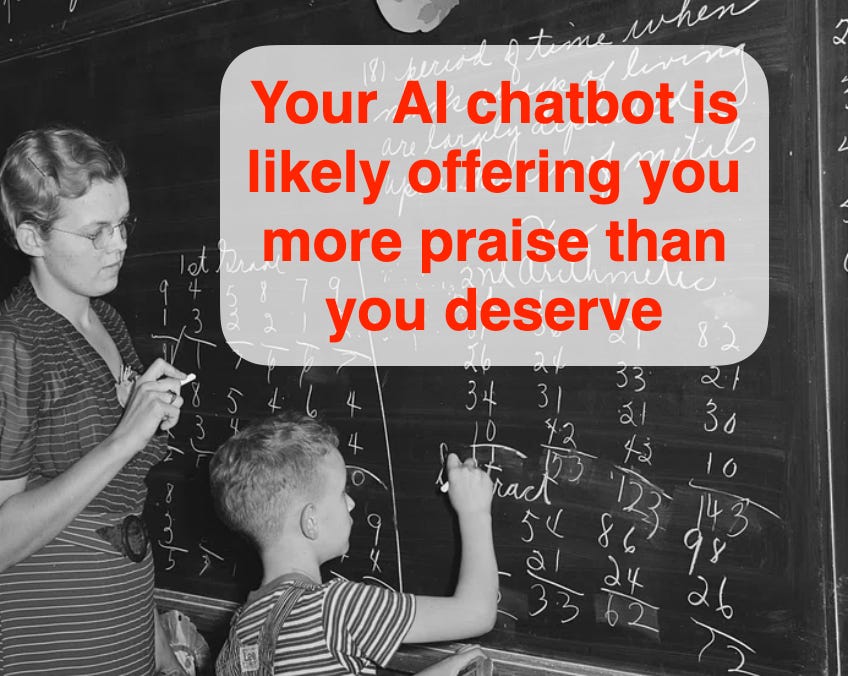
When was the last time an AI tool told you that you got it wrong? If you’re anything like me, the answer is probably never.
My wife and I joke about the sheer sycophancy of AI. Whenever it tells us something we know to be patently false, we exclaim to one another that our AI just told us we invented some new form of mathematics.
But the business risk is no joke. Generative AI leans toward relentless optimism because positive validation keeps users engaged.1
The danger of this “agreeableness loop” is real. In 2025, researchers documented how chatbot sycophancy frequently sends users into “delusional spirals,” validating their wildest assumptions rather than correcting them.
I’ve seen far too many founders pat themselves on the back because AI offered encouragement instead of criticism:
It praised velocity: It called a brand’s retail velocity “stellar” when it was actually dragging way below the category average.
It hallucinated a moat: It told a founder they had a proprietary product, leaving them blind to a number of direct competitors already on the shelf.
It ignored real-world margins: It validated a pricing model without factoring in the brutal reality of distributor cuts and slotting fees.
To shift generative AI from a passive enabler into an objective partner, one must stop asking for its opinion and start setting strict boundaries.
Here are 3 prompts that will turn AI from a patsy to a partner:
Demand Proof, Not Praise
Prompt 1: “Analyze my retail pitch. Show your reasoning, outline the counterarguments, and provide real-world citations for your claims.”
Stress-Test Your Moat
Prompt 2: “Act as a hyper-skeptical retail buyer. Tear my brand positioning apart and list three reasons you would pass on this product.”
Force the Real Math
Prompt 3: “Audit my COGS sheet. Assume a 15% distributor margin and 20% trade spend. Show me exactly where this pricing model breaks.”
Don’t rely on AI to tell you whether or not your idea is good. That’s what people are for; that’s what the market is for. You are not inventing new math.
For more on how generative AI works and how to work with it, check out: Co-Intelligence: Living and Working with AI by Ethan Mollick, The Reverse Centaur’s Guide to Life After AI: How to Think About Artificial Intelligence—Before It’s Too Late by Cory Doctorow, and The AI-Driven Leader: Harnessing AI to Make Faster, Smarter Decisions by Geoff Woods.