
Beyond the Search Bar: Navigating the New Funnel of Beverage Brand Discovery
The most valuable conversations about your brand are happening in places you're likely overlooking
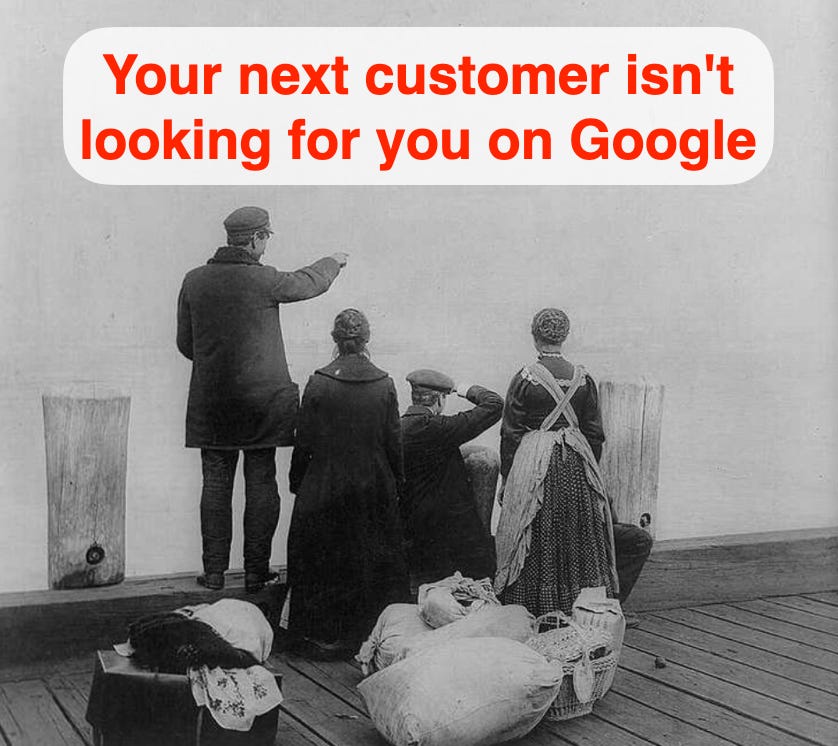
In 1736, London’s “Gin Craze” forced the spirits trade underground. To survive, vendors created the “Puss and Mew,” a wooden cat mounted on a wall where a passerby would whisper a code and drop a coin into its mouth. Gin wasn’t found on a billboard; it was found by those who knew exactly which alleyway to turn down.1 Today’s digital landscape has brought us full circle: discovery is no longer about who is the loudest, but who is whispered about in the right spaces.
Modern discovery has moved beyond “Google it.”2 For drinks brands, the path to purchase is now a funnel of ambient discovery and deep-niche validation. Here is where you need to show up:
1. The Top of Funnel: “Vibe” Discovery (TikTok & Spotify)
This is the new “front door.” Discovery here is passive and aesthetic.
The Tactic: Don’t sell the liquid; sell the ritual, the vibe, the feeling.
Examples: WhistlePig wins on TikTok with “edu-tainment” that feels like a creator’s post, not a brand’s ad. Non-alc brand Ghia uses curated Spotify playlists to own the “pre-dinner mindset” long before the bottle is opened.
2. The Mid-Funnel: The New “Sources of Truth” (AI Search & Reddit)
When curiosity turns into intent, consumers look for “unfiltered” data.
AI Search: Search is shifting toward “answer engines.” Brands like Fortaleza Tequila and Foursquare Rum dominate Perplexity and Gemini results because they’ve seeded technical data across high-authority blogs and forums.3 Treat your mash bills, aging conditions, and ester counts as “training data.” If you aren’t publishing this data on high-authority sites like Substack or Medium, you are letting the AI hallucinate your brand story, or worse yet, ignore it.
Reddit: In communities like r/bourbon, r/tequila, and r/rum, marketing fluff is a liability. You don’t “target” these users; you earn them. Host AMAs or share “behind-the-curtain” production secrets. If you provide raw value, the community becomes your most vocal sales force.
3. The Bottom Funnel: Conviction (Niche Apps & Dark Social)
This is where the actual purchase decision is codified by enthusiasts.
Niche Communities: Platforms like Agave Matchmaker, Whiskybase or Rum Ratings are the final hurdle. A high score here is worth more than a dozen billboards because it offers peer-vetted “proof.”
The Dark Social Layer: The most influential conversations in high-end spirits happen in “dark” spaces—closed Discord servers, WhatsApp groups, and Telegram channels. This is where “allocation hunting” and “bottle flipping” hype is born. You can’t buy your way into these groups, but you should be monitoring them.
Measuring Success
The old “cost-per-click” (CPC) metric is now a lagging indicator of an obsolete strategy. To measure modern influence, founders and marketing managers need to consider:
Share of Model: How often does an AI “Answer Engine” recommend your brand when asked for a recommendation in your category?
Sentiment over Volume: Don’t just track mentions; track the “authority” of the person mentioning you. One positive thread on a niche Discord is worth 1,000 “likes” from a broad audience.
Data Density: Is your technical data (production specs, terroir, provenance) easily accessible and indexable?
For more on the history of gin, see The Weird & Wonderful Story of Gin: From the 17th Century to the Present Day by Angela Youngman.
While The New York Times tech columnist suggests “steering clear of using [Google’s] AI Mode as a regular search engine,” many will ignore that advice. It’s worth noting that when it comes product research, “A.I. search beats an old-school google search.”
Note that because generative AI is probabilistic rather than deterministic, your individual results for these links might vary.