
How SKUs Skew
Big brands need a dozen-plus flavors, but emerging brands win with far fewer
Somewhere along the line, a lot of beverage founders became convinced that adding more flavors to their brand lineup was the key to scaling fast. Look at the headlines and you’ll see that the largest brands have the biggest books. It’s natural to assume SKUs are the reason for scale, but, as is usually the case, correlation does not equal causation.
For early-stage founders, prematurely launching 15 flavors is a trap. A huge portfolio isn’t how a brand (or distributor) grows. It’s just what brands look like after they’ve already won.
Most successful brands and portfolios rely on their core or hero SKU.1
When you branch out, you inevitably tie up cash in slow-moving inventory, split the marketing budget across too many messages, and hide weak single-SKU velocity behind aggregate revenue.
I looked at RTD acquisitions between 2024 and 2026, and the numbers back this up:
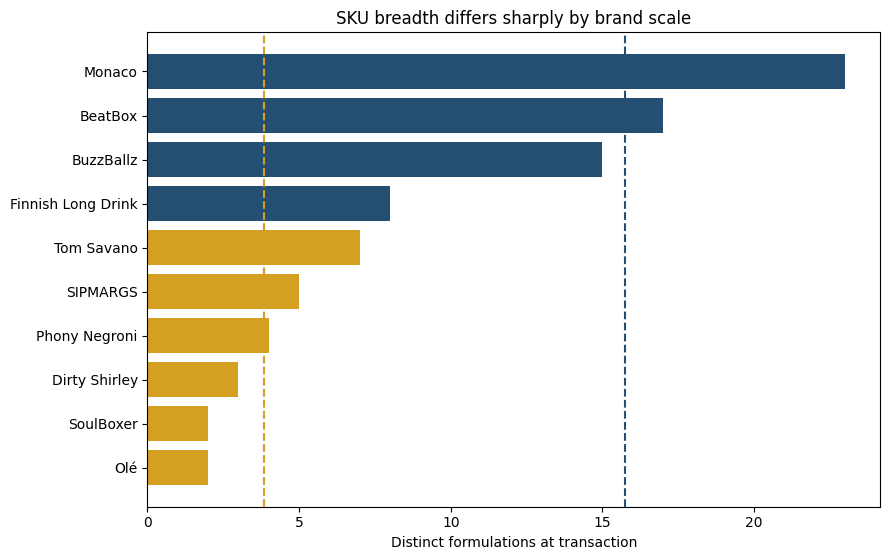
Emerging brands transacted with an average of just 4 core SKUs. Brands like Olé and SoulBoxer exited with only 2, while Phony Negroni had 4.
Scaled platforms averaged 16 SKUs, led by heavyweights like Monaco with 23 and BuzzBallz with 15.
What separates the emerging brands from the scaled ones? Volume and distribution.
When acquired, BuzzBallz was reported at approximately 7 million nine-liter cases and roughly $500 million in annual revenue.2
Contrast this with Phony Negroni, which sold approximately 59,000 nine-liter cases in 2025.
It’s tempting for early-stage founders to copy the big players, but a massive portfolio is a result of scale, not the cause of it.3
Giant brands can justify 20 flavors because they already have national velocity and distribution. Startups can’t.
Acquirers can invent new flavors on their own, they can cook them up in a lab tomorrow. What they’re actually buying is proven consumer demand, retail momentum, and clean margins.
SKU count should therefore be treated as an outcome metric, not the primary objective. A three-SKU brand with strong velocity and enviable margins is generally more valuable than a fifteen-SKU brand with fragmented sales.
NIQ Analysis of US retail shelf performance across beverage and alcohol categories reveals that over 78% of active SKUs contribute less than 2% of overall category sales. The vast majority of sales are locked into the top 2–3 leading SKUs per brand.
Here are the numbers for the rest of the scaled brands:
BeatBox was above 12 million cases and $350 million in 2025 retail sales when Anheuser-Busch agreed to buy 85% of the company.
Finnish Long Drink reached approximately 3.3 million nine-liter cases in 2025, while Monaco was already at approximately 2.5 million cases in 2022.
A 2025 study from the Ehrenberg-Bass Institute across 34 CPG categories found that while large brands do have larger portfolios, simply expanding your SKU count shows almost no effect on driving market share or attracting new buyers.