
The Three-Ingredient Recipe for a Memorable Product Story
Here's how to transform your dry product data into a compelling human narrative
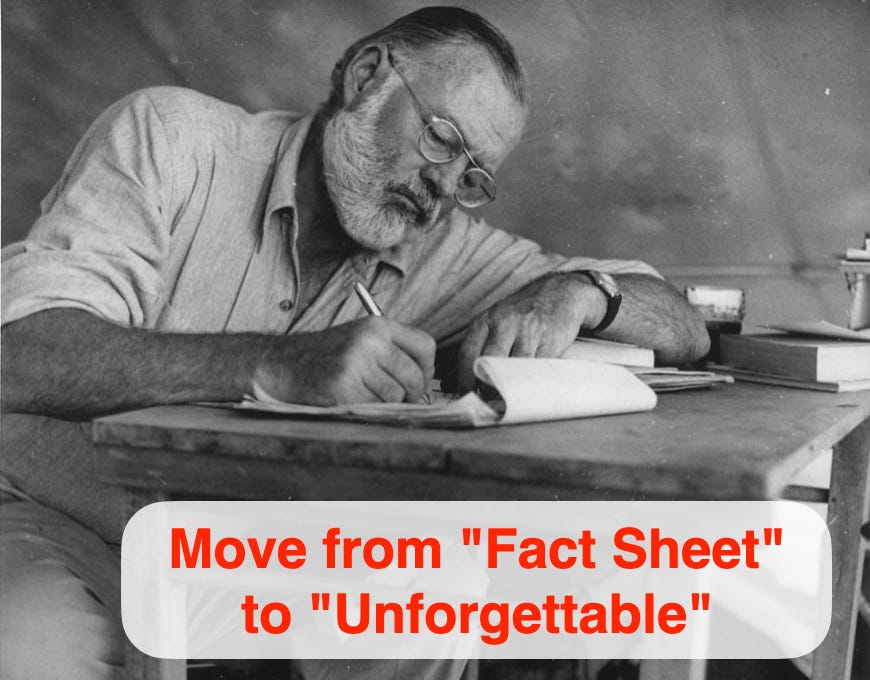
Legend goes: Ernest Hemingway was challenged to write a story in just six words. He penned, “For sale: Baby shoes, never worn.”
Let that sink in.
Hemingway didn’t attempt to list an inventory of narrative components.1 He understood that a single, poignant image carries more weight than a catalog of facts.
In aggregate, the beverage industry, has never fully understood this.
Most product descriptions read like resumes, a collection of neutered facts:
“This wine is from Napa, made from Sauvignon Blanc by a second-generation grower.”
Fully accurate and completely forgettable.
To make a story more compelling, consider including the following three ingredients:
Relative Comparison: Use superlatives or scale to provide context. Is it the most or least something? Or the first?
Analogy/Simile/Metaphor: Give the brain a memorable mental shortcut.2
The “Who:” Connect the “what” to a human “why.” It could be about who the product is for or who made it. This is the “because” of it all.
Apply these techniques critically and note the wholesale transformation of our previously bland product story:
“This Sauvignon Blanc comes from the most biodiverse vineyard in California based on a UC Davis study. It was planted as a labor of love for the grower’s father, who refuses to drink the heavy reds Napa is famous for. She says crafting a delicate white wine in a region obsessed with bold Cabernets is like trying to play a solo flute in the middle of a heavy metal concert—you have to be technically perfect just to be heard.”
Facts inform, but stories stick.3 If you want your product to be more than a line item, stop selling the specs and start telling them better.
In fact, Hemingway never actually wrote that six word story, but the enduring legend only serves as testament to the impact of quality storytelling.
For those who want a middle school refresher:
Metaphors say X is Y. They are direct and vivid.
Example: “Her words were a knife.”
Similes say X is like/as Y. They are explicit and descriptive.
Example: “He is as stubborn as a mule.”
Analogies say X is to Y as A is to B. They are explanatory and argumentative.
Example: “Just as a sword is the weapon of a warrior, a pen is the weapon of a writer.”
For more on analogies, check out: Shortcut: How Analogies Reveal Connections, Spark Innovation, and Sell Our Greatest Ideas by John Pollack. For more on the power of metaphor, see the classic: Metaphors We Live By by George Lakoff and Mark Johnson.
For more on this topic, read Made to Stick by Chip and Dan Heath. I’ve recommended it before as a breezy and comprehensive read how to improve stories.